EXW vs FOB vs DDP: What’s the Difference?
In global trade, the price isn’t the only thing that determines your profit. Often, it’s the three letters in your contract—EXW, FOB, or DDP—that decide whether you gain or lose. EGT Shipping & Logistics breaks down these key Incoterms so you can choose confidently, ship efficiently, and avoid costly surprises.
What Are Incoterms?
Incoterms stands for International Commercial Terms—the globally recognized rules that define the responsibilities of buyers and sellers in international trade. Established by the International Chamber of Commerce (ICC) in 1936, Incoterms are updated every 10 years to reflect changes in global trade. The current version, Incoterms 2020, is the standard in use today. In practice, these rules serve as the common language of global trade, clarifying who handles shipping, costs, risks, and customs clearance at every stage of the transaction.
What Are Incoterms?
Incoterms stands for International Commercial Terms—the globally recognized rules that define the responsibilities of buyers and sellers in international trade. Established by the International Chamber of Commerce (ICC) in 1936, Incoterms are updated every 10 years to reflect changes in global trade. The current version, Incoterms 2020, is the standard in use today. In practice, these rules serve as the common language of global trade, clarifying who handles shipping, costs, risks, and customs clearance at every stage of the transaction.
The Importance and Purpose
These terms precisely define the obligations of both the seller and the buyer in international trade contracts, governing the sale between them. They cover three main areas:
- Cost Distribution: Who bears the costs of shipping, insurance, and customs?
- Risk Transfer Point: At what point does responsibility for damage or loss of goods transfer from the seller to the buyer?
- Arrangement Responsibility: Which party is responsible for arranging transportation and obtaining documents?
Definitions of the Three Terms: EXW – FOB – DDP
What is EXW – Ex Works
(Delivery at the Seller’s Premises)
Under EXW, the seller is only responsible for preparing the goods at their factory, warehouse, or any designated location. The buyer bears all costs, obligations, and risks associated with receiving the goods.
Seller’s Responsibilities under EXW
The seller is required to prepare the goods at their factory or warehouse with no further obligations. However, in some countries, under EXW, the seller loads the goods onto the inland carrier without charging a fee.
Buyer’s Responsibilities under EXW
Upon taking delivery at the seller’s warehouse, the buyer assumes all costs, risks, and liabilities associated with the onward transportation of the goods:
- Loading and transportation fees from the seller’s warehouse to the inland carrier for delivery to the port of shipment.
- Customs clearance procedures and all costs related to the export process.
- All charges related to handling the goods inside the port of shipment, such as container handling, freight charges, and storage costs at the port, if necessary.
- Sea freight to the port of destination.
- Unloading terminal fees at the port of destination.
- Customs duties and import taxes at the port of destination.
- Inland transportation costs to move the goods from the port of destination to the buyer’s warehouse.
- Unloading the goods from the inland carrier into the warehouse in the buyer’s country.
What is FOB – Free on Board
(Delivery on Board the Vessel – Sea and Inland Waterway Only)
Under FOB, the seller delivers the goods on board the vessel at the buyer’s designated port of shipment. The seller covers all costs and risks up to that point. Once the goods are on board, responsibility and risk transfer to the buyer.
Seller’s Responsibilities under FOB
- Preparing and packaging the goods in the warehouse to be ready for loading onto the inland carrier.
- Inland transportation costs.
- Preparing all shipping documents, such as the commercial invoice, bill of lading, packing list, insurance certificate if requested, and customs clearance.
- Goods storage costs, freight forwarder fees, and terminal handling charges at the loading port.
- The seller is not obligated to provide insurance for the buyer, but may arrange insurance for the goods up to the loading terminal as part of their commitment. If the buyer requests it, the seller can assist with insurance and customs arrangements.
Buyer’s Responsibilities under FOB
- Sea freight costs from the port of shipment to the port of destination and their own warehouse, plus insurance costs and any costs related to loading and unloading.
- Responsibility for customs clearance at the port of destination, based on the seller’s responsibility to complete export customs clearance at the port of shipment.
- All documents related to importing the goods.
- Transportation costs from the moment the goods are loaded on board the vessel until they reach their warehouse.
- The buyer is responsible for unloading and storing the goods after the shipment arrives in their country.
What is DDP – Delivered Duty Paid
(Delivery with Duty Paid to the Buyer’s Door)
With DDP, the seller covers all costs and risks right up to the buyer’s door, including customs and taxes. This is the only Incoterm where the seller pays import duties. Once the goods reach the agreed location, responsibility passes to the buyer. Both parties can decide on that location in advance.
Seller’s Responsibilities under DDP
- Loading and unloading the goods.
- Arranging transportation to the location agreed in the contract, whether by road, sea, or to the specified site.
- Customs clearance procedures and payment of all associated fees, including handling export and import customs, and paying all taxes and duties required in the destination country.
- Providing the following documents:
- Bill of Lading
- Commercial Invoice
- Insurance Certificate, if requested
- Packing List
- Export License
Buyer’s Responsibilities under DDP
Unloading the goods: Once the seller delivers the goods, the buyer must unload them. If the delivery point is a port in the buyer’s country, they are also responsible for moving the goods from the port.
Transport and delivery terms: Generally, the buyer does not participate in transportation or delivery activities under DDP. However, if the specified delivery location is a port within the buyer’s country, they must cover inland transport costs to their warehouse.
Costs: Since the seller provides all necessary documents, DDP does not impose any costs on the buyer except those arising after receiving the goods.
Customs and duties: The buyer does not handle customs clearance, as the seller undertakes it. However, in some cases involving risks in customs procedures, the buyer may handle it due to greater familiarity with local laws such as GST or VAT.
When to Choose Each Term?
Choose EXW if:
- You have a strong logistics network in the seller’s country and want full control over cost and service.
- You plan to consolidate shipments or use pre-negotiated freight contracts.
- The supplier is small or inexperienced in exporting.
Advantages: Simple pricing from the seller and greater control for the buyer.
Limitations: Early and heavy burden on the buyer, and may include export responsibilities.
Choose FOB if:
- Your shipment is by sea, and you want the seller to handle export procedures and loading.
- You have a preferred freight forwarder or shipping line and negotiate sea freight yourself.
- You want clear pricing: the seller up to the vessel, and you afterward.
Advantages: Logical cost distribution for sea trade, widely understood and used.
Limitations: Applicable only to sea transport, requires precise coordination for sailing dates and proof of loading.
Choose DDP if:
- You want “door-to-door” delivery with minimal administrative burden.
- You are buying small or urgent shipments and focusing on sales.
- The seller has reliable representation and clearance expertise in your country.
Advantages: Maximum convenience for the buyer with an all-inclusive price to the door. Limitations: Heavy burden on the seller, and tax and customs responsibilities that may affect pricing.
Quick Comparison
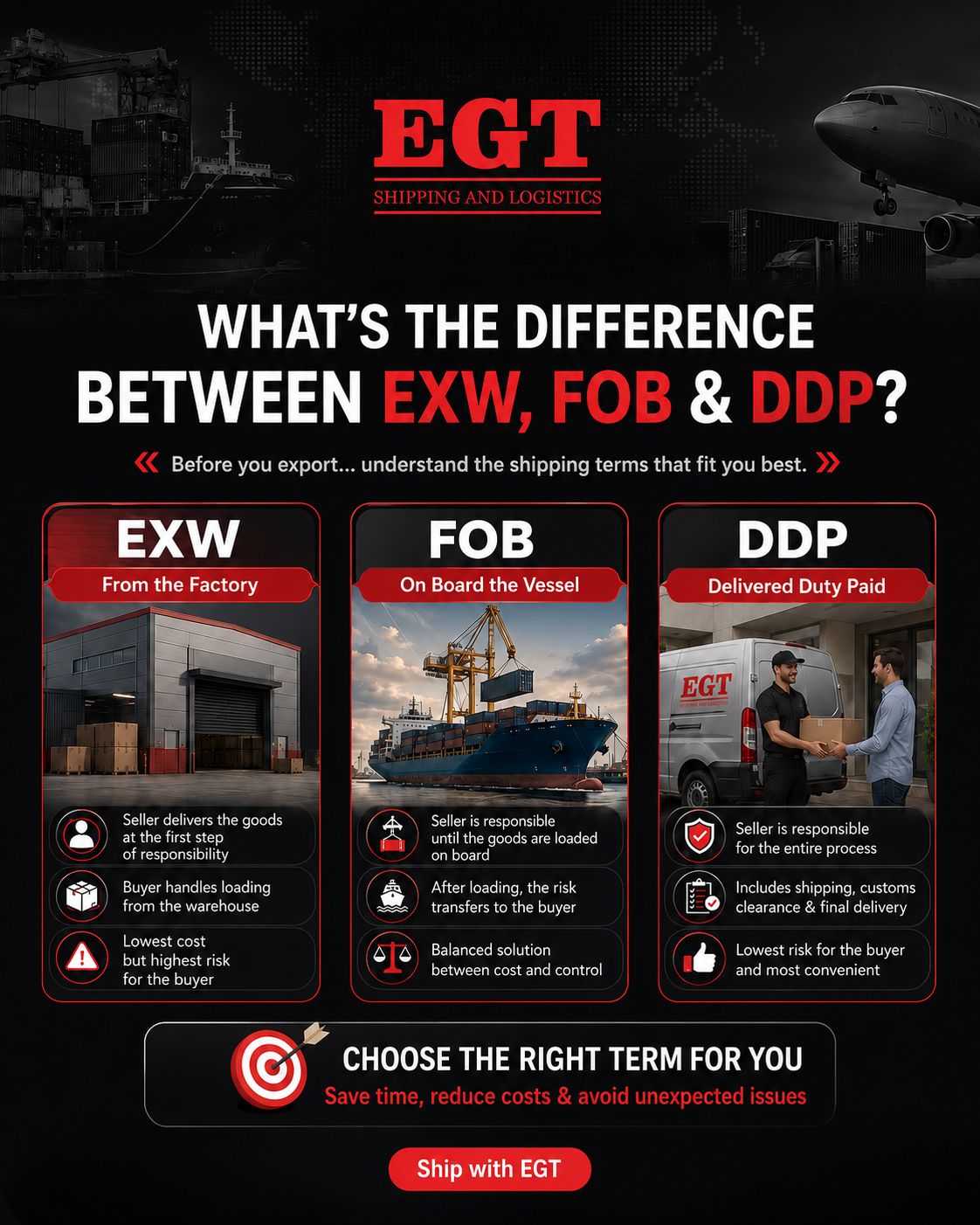
EXW: The buyer covers all costs and risks from the seller’s warehouse onwards.
FOB: The seller covers costs and risks up to loading the goods on board. The buyer handles shipping and beyond.
DDP: The seller covers all costs and risks up to the buyer’s door, including duties and taxes.
| EXW | FOB | DDP |
|---|---|---|
| Ex Works | Free On Board | Delivered Duty Paid |
| The buyer assumes responsibility from the very first step | The seller is responsible until the goods are loaded onto the ship | The seller bears full responsibility |
| Goods are collected from the supplier’s premises | After shipment, responsibility transfers to the buyer | Includes shipping, customs clearance, and final delivery |
| Lower initial cost but higher risk for the buyer | A balanced solution between cost and control | Less risk for the buyer and greater convenience |